
Here’s a question worth sitting with: if a stranger found your website right now, with no referral, no recommendation, nothing but a search result, would they trust you within the first ten seconds?
That’s the reality every business operates in online. No handshake, no small talk, no chance to build rapport before the pitch. Just a page, and a person deciding fast whether you’re worth their time. Content marketing is one of the only tools that actually earns that trust instead of asking for it.
People do their research before they even speak to you.
By the time someone reaches out to a business now, they’ve usually already read a handful of articles, skimmed some reviews, maybe compared three or four competitors. The decision is half-made before the first conversation happens. That means the content sitting on your site and in search results is doing sales work whether you planned for it to or not. If it’s thin, generic, or clearly written to please a search algorithm rather than a person, that gets noticed. If it’s genuinely useful, that gets noticed too.
Helping first, without expecting anything back.
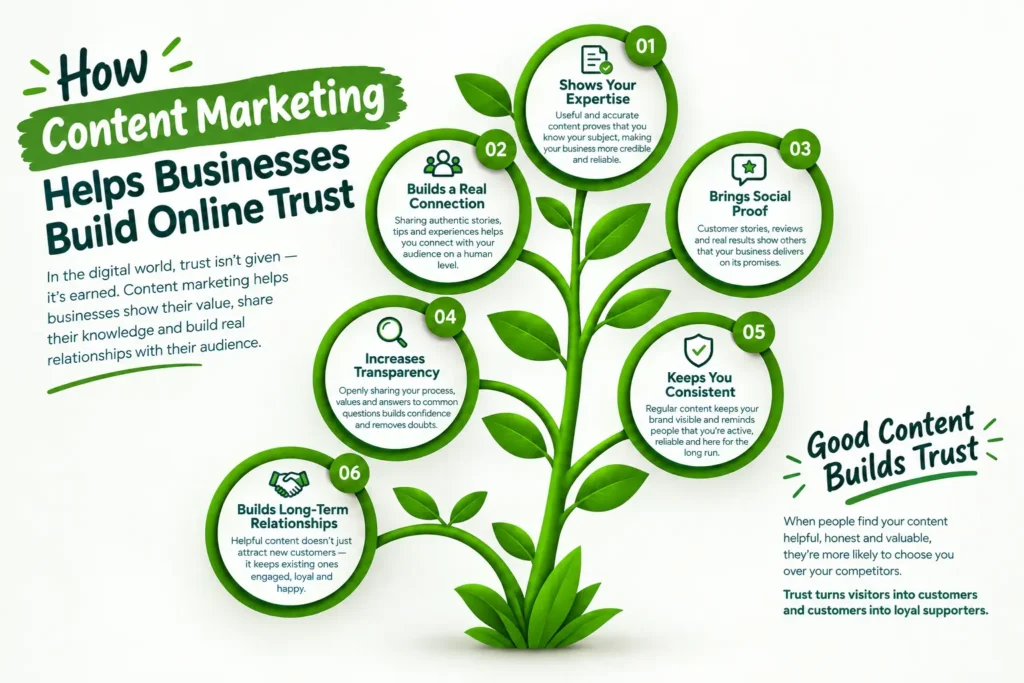
Think about the last time a company answered a question you had before you’d spent a cent with them. Did it change how you saw them? Probably. That’s the whole mechanism behind content marketing. A landscaping business that writes an honest guide on when it’s actually worth reseeding a lawn versus starting over isn’t just producing SEO fodder — it’s proving, in public, that it knows what it’s doing. When that reader eventually needs the work done, guess who they call first.
Showing up matters more than showing off.
One polished article won’t convince anyone of much. But a company that keeps publishing solid, accurate content over months and years starts to feel dependable in a way that’s genuinely hard to fake. Readers pick up on patterns without even trying to. A brand that keeps delivering value looks stable. A brand that posted once in 2022 and went quiet looks like it’s not really paying attention anymore.
Real examples beat big claims.
“We’re industry leaders” convinces no one. A detailed story about an actual client, an actual problem, and how it got solved — including the parts that didn’t go perfectly — convinces people, because it’s specific. Specificity is what distinguishes content that builds trust from content that merely fills space.
Letting the work speak for itself.
You don’t have to tell people you’re an expert if your content already proves it. Deep, well-reasoned articles that go past the surface-level advice everyone else is publishing tend to do more for a brand’s credibility than any tagline. It also happens to be what search engines increasingly reward, so the two goals line up.
Trust builds slowly, and that’s fine
No one trusts a company based on a single great blog post.. Trust here works the same way it does anywhere else — a series of small, consistent, honest interactions that add up over time. A helpful answer this month, a transparent case study next month, a willingness to actually respond when someone comments or asks a question. Taken in isolation, none of this is dramatic. Together, it becomes a reputation that’s genuinely difficult for a competitor to copy with a bigger ad budget.
Content marketing earns trust because it doesn’t demand anything upfront. It offers something useful first and lets the relationship grow from there, the same way trust has always worked between people. For businesses willing to stay consistent with it, what they end up building isn’t just traffic or leads — it’s a reputation that holds up when someone actually looks closely. And online, that’s rarer, and more valuable, than almost anything else you could put on a page.