
How AI Is Revolutionizing Digital Marketing
Artificial Intelligence (AI) is reshaping the way businesses connect with customers. What once required hours of manual work can now be completed in minutes with AI-powered tools. From content creation and customer support to data analysis and personalized advertising, AI is helping marketers work more efficiently while delivering better experiences to their audiences.
Digital marketing has become increasingly data-driven, and businesses that use AI can better understand customer behavior, predict market trends, and create campaigns that achieve stronger results. Whether you run a startup, an online store, or a large enterprise, AI has become a valuable partner in building smarter marketing strategies.
This article explores how AI is transforming digital marketing, the benefits it offers, and why businesses should embrace AI to stay competitive in the digital age.
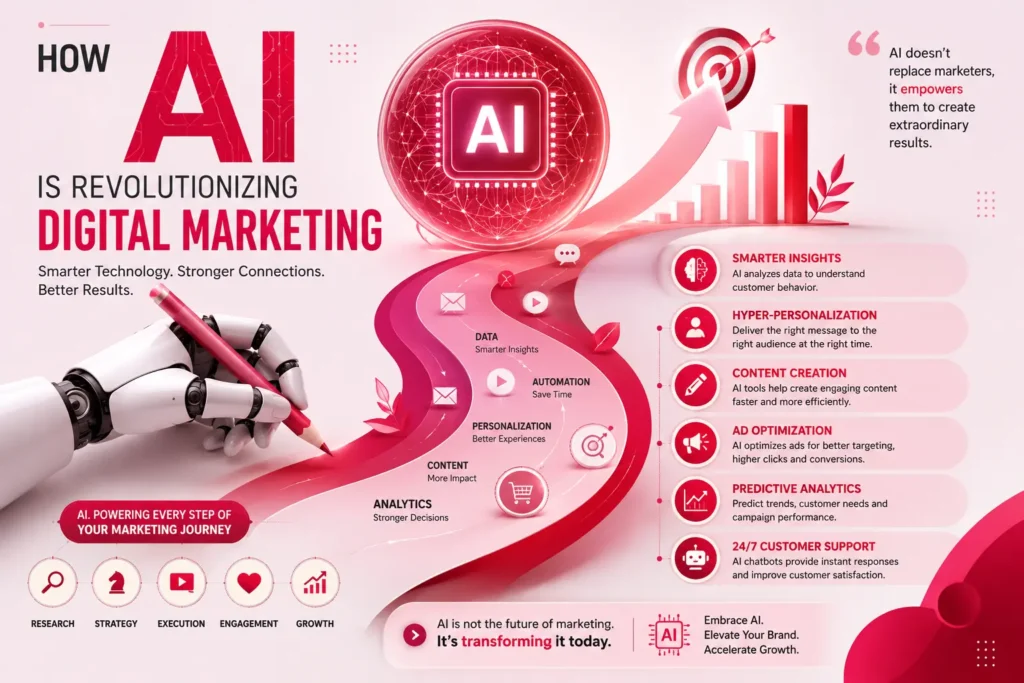
What Is AI in Digital Marketing?
Artificial Intelligence in digital marketing refers to the use of intelligent software and machine learning technologies to automate tasks, analyze data, and make marketing decisions more efficiently. AI systems can process vast amounts of information, recognize patterns, and provide insights that help businesses improve marketing performance.
Instead of replacing marketers, AI enhances their abilities by handling repetitive tasks and providing valuable recommendations based on real-time data.
1. Smarter Customer Insights
One of AI’s greatest strengths is its ability to analyze customer data quickly and accurately. AI examines browsing history, purchasing behavior, social media interactions, and website activity to understand customer preferences.
With these insights, businesses can:
- Identify target audiences more accurately
- Understand customer interests
- Predict future buying behavior
- Improve marketing strategies
Better customer understanding leads to more effective campaigns and higher customer satisfaction.
2. Personalized Customer Experiences
Modern customers expect brands to deliver relevant content and recommendations. AI makes personalization possible by tailoring messages, product suggestions, emails, and advertisements based on each user’s interests.
Examples include:
- Personalized email campaigns
- Product recommendations in online stores
- Customized website experiences
- Individualized promotional offers
Personalized marketing improves engagement, builds trust, and increases conversion rates.
3. Faster Content Creation
AI-powered writing assistants help marketers generate ideas, draft blog posts, create social media captions, write product descriptions, and develop email campaigns more efficiently.
Although AI speeds up content production, human creativity remains essential for adding originality, emotional connection, and brand personality.
Benefits include:
- Faster content production
- Improved productivity
- Consistent publishing schedules
- More time for strategic planning
4. Better Search Engine Optimization (SEO)
SEO is essential for increasing website visibility, and AI is making optimization more effective than ever.
AI tools can:
- Discover valuable keywords
- Analyze competitors
- Improve content structure
- Suggest internal linking opportunities
- Identify technical SEO issues
These insights help businesses create content that better matches user intent and improves search engine rankings.
5. Improved Advertising Performance
Digital advertising platforms already use AI to optimize campaigns automatically.
AI helps marketers by:
- Identifying high-performing audiences
- Adjusting bids in real time
- Testing multiple advertisements
- Predicting campaign performance
- Reducing wasted advertising spend
As a result, businesses achieve better returns on their advertising investment.
6. AI Chatbots for Customer Support
AI-powered chatbots provide instant responses to customer questions at any time of day.
Chatbots can:
- Answer common questions
- Recommend products
- Schedule appointments
- Collect customer information
- Guide users through purchases
This improves customer satisfaction while reducing the workload for customer service teams.
7. Predictive Analytics
AI doesn’t just analyze past performance—it helps predict future outcomes.
Predictive analytics enables businesses to:
- Forecast customer demand
- Identify future market trends
- Estimate campaign success
- Reduce marketing risks
- Make informed business decisions
This proactive approach allows businesses to stay ahead of competitors.
8. Social Media Management
Managing multiple social media platforms can be time-consuming. AI simplifies this process by helping marketers schedule content, monitor conversations, analyze engagement, and recommend the best posting times.
AI can also identify trending topics and hashtags that increase content visibility and audience engagement.
9. Email Marketing Automation
Email remains one of the highest-performing digital marketing channels. AI enhances email marketing by automatically selecting the best sending time, creating personalized subject lines, and segmenting audiences based on customer behavior.
Benefits include:
- Higher open rates
- Better click-through rates
- Increased conversions
- Improved customer relationships
Automation allows businesses to communicate with customers consistently without requiring constant manual effort.
10. Better Marketing Decisions Through Data
Every digital marketing campaign generates valuable data. AI transforms this information into meaningful insights by identifying patterns that humans may overlook.
Businesses can use AI-powered analytics to:
- Measure campaign performance
- Track customer journeys
- Improve marketing strategies
- Allocate budgets more effectively
- Increase overall return on investment
Data-driven decision-making leads to smarter investments and long-term business growth.
Challenges of Using AI in Digital Marketing
While AI offers many advantages, businesses should also be aware of its limitations.
Some common challenges include:
- Maintaining customer data privacy
- Avoiding over-reliance on automation
- Ensuring human creativity remains part of content creation
- Monitoring AI-generated content for accuracy
- Training employees to use AI tools effectively
The best results come from combining AI efficiency with human expertise.
Best AI Tools for Digital Marketers
Many AI-powered platforms are helping marketers improve productivity and campaign performance.
Popular categories include:
- AI writing assistants for blogs and social media
- SEO optimization tools
- AI-powered design platforms
- Marketing automation software
- Customer support chatbots
- Analytics and reporting tools
Choosing tools that align with your business goals can significantly improve marketing efficiency
The Future of AI in Digital Marketing
Artificial Intelligence will continue to transform digital marketing in the coming years. Businesses can expect even greater personalization, smarter automation, voice search optimization, predictive customer experiences, and more advanced marketing analytics.
Companies that embrace AI today will be better prepared to adapt to changing customer expectations and evolving technology. Rather than replacing marketers, AI will continue to support creative professionals by simplifying repetitive tasks and providing deeper insights for strategic decision-making.
Final Thoughts
Artificial Intelligence has become one of the most powerful innovations in digital marketing. It enables businesses to automate repetitive tasks, understand customer behavior, personalize marketing campaigns, improve search engine optimization, optimize advertising performance, and make better decisions using real-time data.
However, successful digital marketing still depends on human creativity, strategic thinking, and authentic communication. AI should be viewed as a powerful assistant rather than a replacement for marketers. By combining intelligent technology with human expertise, businesses can build stronger customer relationships, improve marketing performance, and achieve sustainable growth in an increasingly competitive digital landscape.