
AI in Content Creation: Is It Replacing Creators or Helping Them?
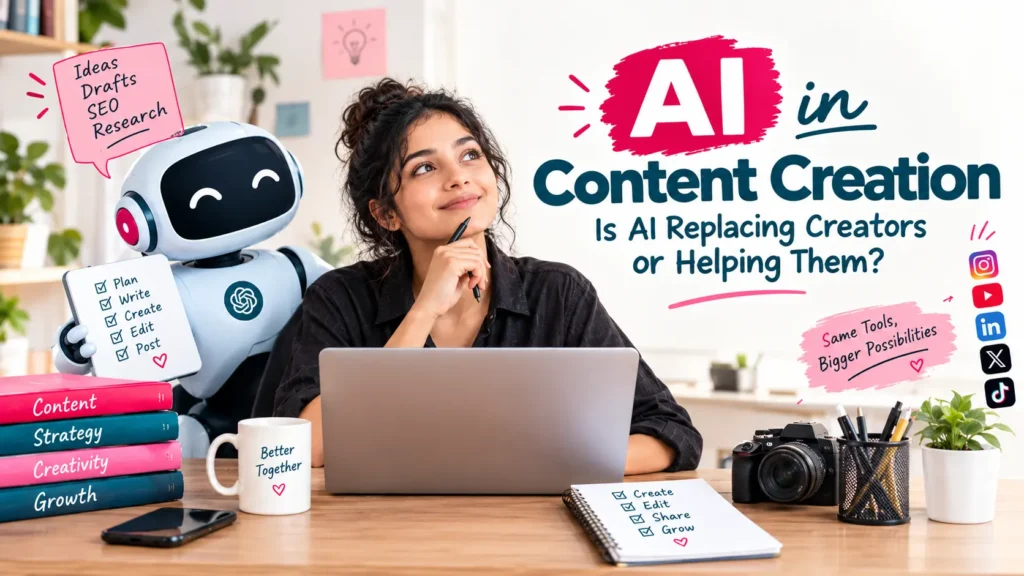
Last year a friend of mine, a freelance writer, told me she’d lost two clients in one month. Both said the same thing: “We’re trying AI for this now.” A few weeks later, one of them came back. The AI drafts were fine, they said, but nobody could tell what the brand actually sounded like anymore.
That story sums up where we are. AI hasn’t wiped out creators, and it hasn’t turned out to be the harmless assistant its fans promised either. The truth sits somewhere messier.
What AI does well
Let’s be fair. AI tools are very good at the dull parts of the job.
Need ten headline options at 11 pm? Done in seconds. Transcribing a one-hour interview? Quick. Turning a long report into a short summary, resizing a video for three platforms, cleaning up background noise in a podcast: all things that used to eat hours now take minutes.
For small creators this matters a lot. A solo YouTuber without an editor or a designer can now produce work that looks far more polished than it would have five years ago. The tools lowered the cost of getting started, and that’s a real benefit.
Where the replacement fear comes from
The fear isn’t made up, though. Some work is already disappearing.
Low-budget, high-volume content is the first to go: generic product descriptions, basic SEO filler articles, stock-style images, simple voiceovers. If a client only cares about having words on a page, a machine will do that cheaper than a person. Many entry-level writers and illustrators who once relied on this kind of work are feeling it now.
There’s also a quieter problem. When the internet fills with similar-sounding AI text, readers get tired. Everything starts to feel like it came from the same place: the same tidy structure, the same safe tone, the same “in conclusion” paragraph. People stop trusting it, and they stop remembering it.
What AI can’t really do
AI can imitate a voice. It can’t have a life.
A travel writer who got sick on a night bus in Munnar has a story. A cook who has burned the same dish five times knows exactly where beginners go wrong. A teacher who has watched a thousand students struggle with the same concept knows how to explain it differently. This kind of experience is what makes content worth reading, and no tool produces it, because it comes from actually having been there.
Taste is another one. AI will give you twenty options, but someone still has to decide which one is good, and why. That judgment is where creators are hardest to replace.
The middle path that’s working
The creators doing well right now aren’t the ones refusing AI, and they aren’t the ones handing everything over to it. They treat it like a fast, slightly clueless intern.
In practice that looks like this:
Using AI for research starting points, outlines and first-pass editing, but writing the actual piece themselves
Fact-checking everything, because these tools state wrong things with total confidence
Adding personal stories, opinions and local detail that a model can’t invent
Keeping a distinct voice, even if that means breaking “perfect” grammar rules
The pattern is simple: AI handles the speed, the human handles the meaning.
A few honest concerns
It would be dishonest to wrap this up neatly, because some problems are still unresolved.
Credit and consent. Many models were trained on creators’ work without asking or paying them. Courts and lawmakers in several countries are still sorting this out.
Disclosure. Should readers be told when AI helped? Many people think yes, and some platforms are starting to require it.
Entry-level jobs. If beginners can’t get the simple jobs where people used to learn, how do they grow into experienced professionals? Nobody has a good answer yet.
So, replacing or helping?
Both, depending on the kind of work and the kind of creator.
If your work is interchangeable, meaning anyone could produce it by following a template, AI is a genuine threat. If your work carries your perspective, your experience and your mistakes, AI is more likely a tool that saves you time.
My advice to anyone creating content right now: don’t compete with AI on speed or volume. You’ll lose. Compete on being specific, honest and recognisably yourself. That’s the one thing a machine still can’t copy.